
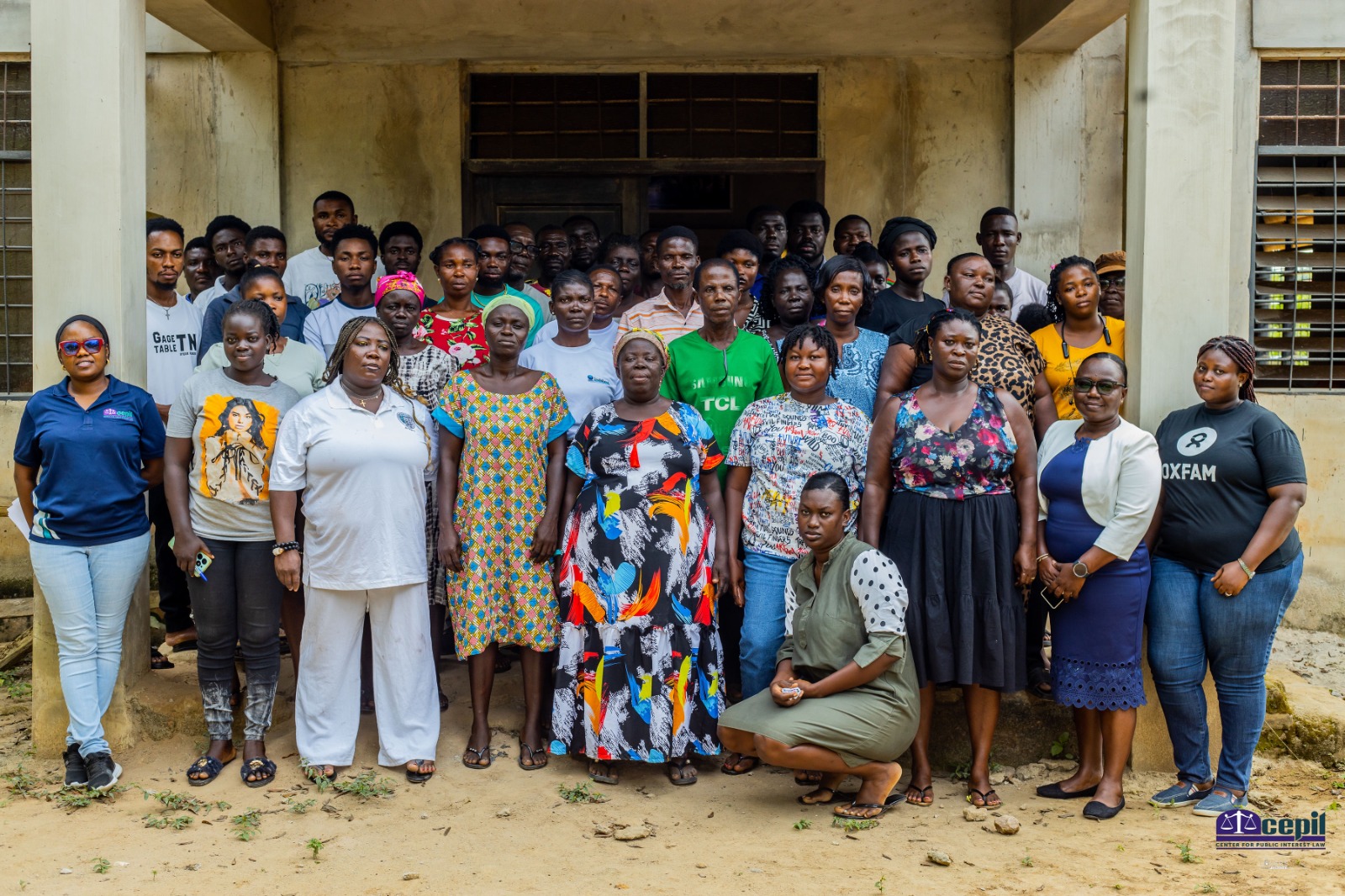
Women and youth leaders from communities affected by the Ewoyaa Lithium Project have used a Town Hall Dialogue on Free, Prior and Informed Consent (FPIC) to demand greater representation in formal project consultations, warning that their voices risk being drowned out by male-dominated and traditional leadership structures.
The dialogue, organised by the Centre for Public Interest Law (CEPIL) under the Feminist Mineral Initiative and funded by Oxfam in Ghana, brought together 52 participants, evenly split between 26 men and 26 women, from Ewoyaa, Krofu, Abonko, Anokye (Anokyi), Krampakrom, Afrangua and Ansadze. The session deliberately created dedicated space for women and youth to ask questions, recognizing that these groups are often underrepresented in formal project consultations.
Women participants raised pointed concerns about how their voices, specifically, could be counted going forward. They noted that project discussions have often been dominated by men and by traditional leadership structures and questioned whether their interests would be genuinely reflected in decisions on resettlement, compensation and land use as the project enters its implementation phase. Their reflections reinforced the value of dedicated, inclusive facilitation spaces and pointed to a recommendation that women be formally represented in ongoing consultation structures rather than relying on traditional leadership alone to convey community views.
Youth leaders, for their part, raised questions about whether young people, many of whom do not yet own land but whose futures are directly tied to the community, have a recognised role in giving or withholding consent. This point highlighted a gap in how consultation processes typically define who counts as an affected rights-holder and underscored the need to include youth explicitly in future engagement structures.
Organisers observed that women and youth participants asked some of the most pointed questions of the session once given dedicated space to do so. A key lesson drawn from the dialogue was that FPIC education is most effective when grounded in participants’ lived experience of a specific, ongoing project rather than presented as an abstract legal concept, and that dedicated space for women and youth surfaces concerns that might otherwise go unheard in mixed or leadership-dominated settings.
CEPIL has recommended that women and youth be formally represented in any ongoing or future consultation structures as the Ewoyaa Lithium Project advances, and that continued community-level FPIC education be provided so that residents can act on their rights rather than treat the concept as purely theoretical. The dialogue also identified the need for a clear, accessible channel through which community members can request project information and raise consent-related concerns.
The Ewoyaa Lithium Project is set to become Ghana’s first commercial lithium mine, spanning seven communities. It moved into its implementation phase following Parliament’s ratification in March 2026 of the mining lease agreement between the Government of Ghana and Barari DV Ghana Limited, a subsidiary of Atlantic Lithium.
