
Our Correspondent, Terchire
The Concerned Farmers Association of Afrisipakrom, Terchire, Susuanso and Adrobaa has exposed what it describes as a fundamental legal contradiction in Newmont’s petition to the Lands Commission, questioning why the mining company was returning to the Minerals and Mining Act to challenge compensation when the State had abandoned that law and used the Land Act to compulsorily acquire the farmers’ lands.
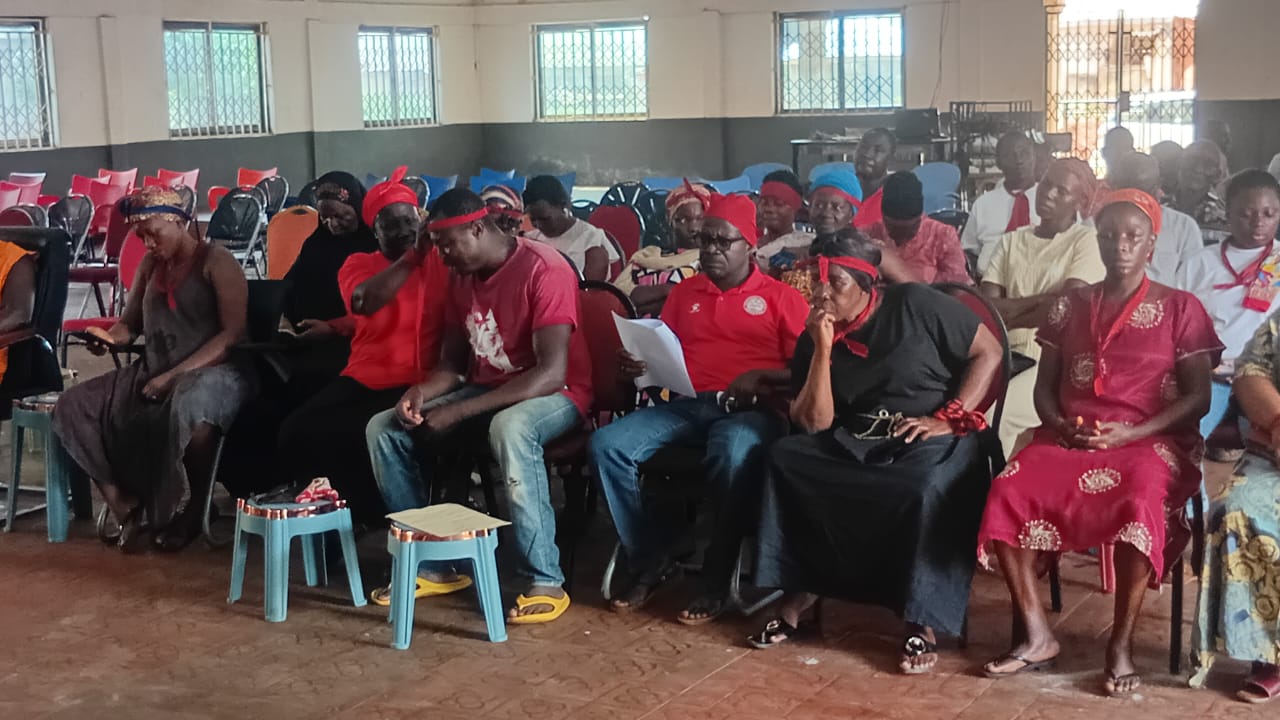
Addressing a press conference at Terchire in the Tano North Municipality of the Ahafo Region on Monday, November 2, the Chairman of the Association, Mr John Mensah, traced the legal history of the acquisition, explaining that the Government had earlier granted Newmont a mining concession under the Minerals and Mining Act, 2006 (Act 703), which was different from the State compulsorily acquiring the lands under the Land Act, 2020 (Act 1036).
“That grant was different from the State compulsorily acquiring our lands under the Land Act, 2020, Act 1036,” he explained.
He said that under Section 73 of the Minerals and Mining Act, landowners and lawful occupiers have a right to compensation when mining operations disturb their rights over the land, and the compensation amount must be agreed between the affected people and the mining company.
“As members of the Concerned Farmers Association, we insisted on our right to negotiate fair and adequate compensation with Newmont before gaining access to our lands,” he said.
Mr Mensah recounted that the company then asked the Ministry of Lands and Natural Resources to intervene, claiming that the farmers were preventing it from working on their lands.
“Newmont claimed that we were preventing it from working on our lands. Our concerns were about our rights, our properties and our livelihoods. We complained about the destruction of farm structures and other properties without our consent and without compensation. We also complained about arrests of affected farmers, which we considered unlawful, and threats against members who tried to protect their properties,” he said.
“Our position is clear: our structures are not speculative under either the mining laws or the Land Act. We strongly reject the claim that our structures are “speculative”. These structures existed long before Newmont planned to extend its mining operations into our area. We lived in them and used them for farming and other farming-related businesses. They were part of our everyday lives and the means by which we supported our families. It is deeply unfair to take our lands, destroy our properties and then describe those properties as “speculative” when it is time to pay compensation,” he underscored.
The Chairman explained that the mining law provides a process for determining compensation and resolving disagreements, and the farmers expected the company and the Government to follow that process.
“However, the Government in 2023 proceeded under a different law, the Land Act to compulsorily acquire selected lands for Newmont’s mining operations and related activities. These included lands belonging to members of our Association,” he said.
He stressed that once the State acquired the lands under the Land Act, compensation for that compulsory acquisition must be assessed and paid under the Land Act.
“The State had now acquired our lands under a different law, the Land Act. This meant that compensation for that compulsory acquisition must be assessed and paid under the Land Act. We therefore submitted ourselves to the procedures under that Act,” he stated.
Mr Mensah questioned why Newmont was now returning to the earlier mining law to challenge payment for the structures.
“We find this shocking and unfair. This is because the process under that mining law had been abandoned in dealing with us and the State had instead used the Land Act, 2020, Act 1036, to acquire our lands for Newmont. We therefore question why Newmont is now returning to the earlier law to challenge payment for our structures,” he said.
He emphasised that under the Land Act, a property is described as speculative only when improvements are made after the Government publishes its notice to acquire the land, and there is no reference to an alleged mining cut-off date.
“We reject that approach in assessing compensation. Under the land law, Act 1036, a property is described as speculative when improvements made after the Government publishes its notice to acquire the land. It makes no reference to an alleged mining cutoff date,” he stated.
In this regard, Mr Mensah called on the Lands Commission to apply the correct legal framework and reject Newmont’s attempt to import mining law provisions into a compulsory acquisition governed by the Land Act.
“The Commission must exercise its own judgment, apply the law fairly and protect the rights of affected property owners,” he said.

