
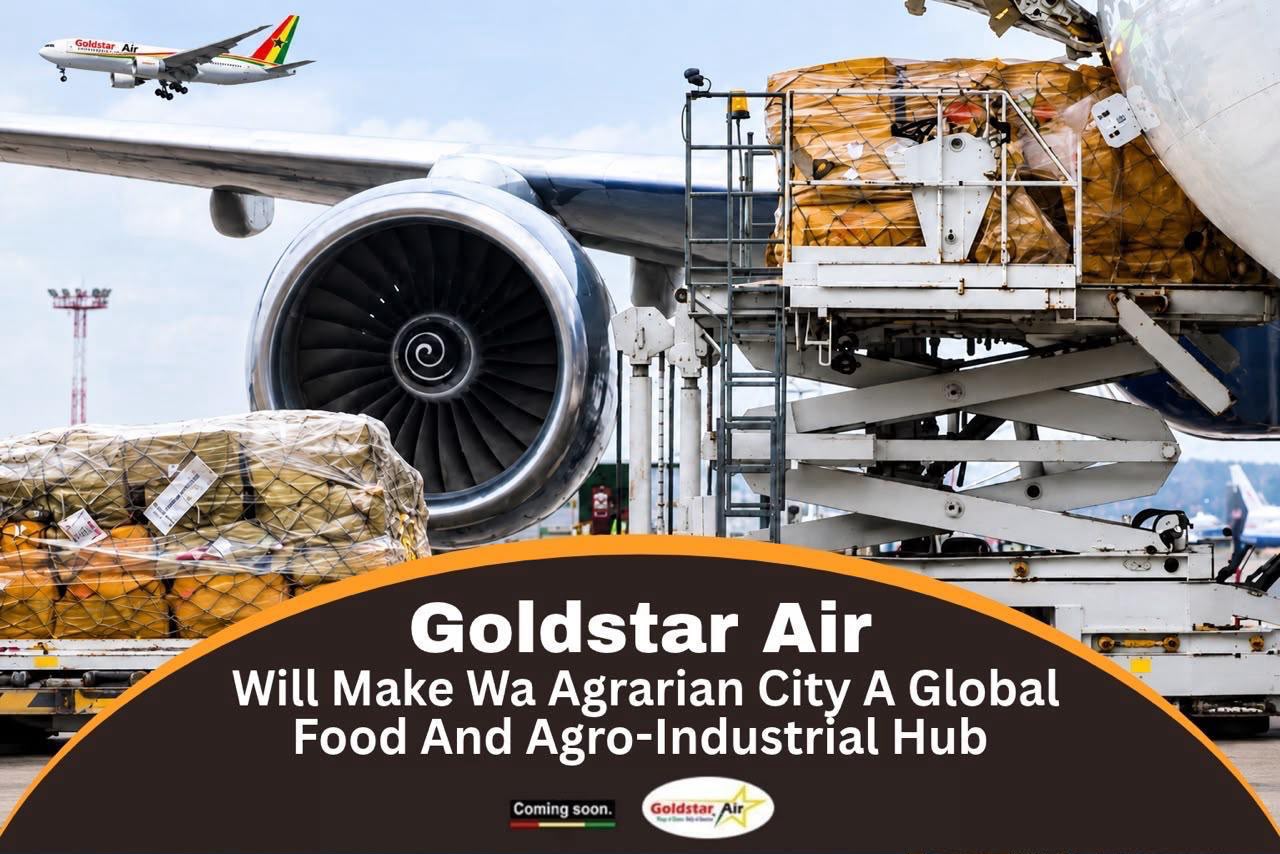
United States and Ghanaian-registered company Goldstar Air, a private international airline with an issued Air Carrier Licence (ACL/N-SCH No. 0239) from the Ghana Civil Aviation Authority (GCAA) and no liabilities as of today, has secured incentives from major airports worldwide. Licensed to operate passenger and cargo flights across West Africa and on intercontinental routes, the airline is set to transform the agrarian city of Wa into a global food and agro-industrial hub, to tap into the global food market, revenue of $9.67 Trillion in 2026, growing at a compound annual growth rate (CAGR) of 6.24% through 2031. Goldstar Air is emerging as a transformative force in the trade and logistics landscape, with initiatives that extend far beyond conventional commercial airline operations. The initiative is also much bigger than an airport; it is about building an economic ecosystem around the airport. Goldstar Air will strategically position the Upper West Region as a global trade and logistics hub, not only by connecting people and goods but also by integrating aviation with broader agricultural activities that will drive industrialization, create jobs, attract foreign direct investment, and expand the region’s participation in global trade and logistics. The Upper West Region possesses the land, people, knowledge, climate, crops, and entrepreneurial spirit required to become a major food-producing and agro-processing centre. However, agriculture cannot reach its full potential when farmers remain disconnected from efficient markets, modern logistics, processing facilities, reliable storage, financing, technology, and international consumers.
Goldstar Air will use its air connectivity as an economic bridge between farms in the Upper West Region and markets across Ghana, Africa, and the rest of the world, as part of the airline’s Project $1 Trillion Foreign Reserve Goal. The initiative is to transform geographical distance from a barrier into an opportunity, agricultural abundance into commercial power, and Wa from a predominantly agrarian economy into a globally connected food and agro-industrial hub. Goldstar Air recognizes agriculture as the dominant economic activity in Wa Municipality, employing approximately 70 percent of the active population, with maize, millet, rice, sorghum, yam, cowpea, groundnuts, and soybeans among the major crops. Across the wider Upper West Region, more than 80 percent of the population is engaged in agriculture, making the region’s agricultural foundation impossible to ignore. The airline’s presence will serve as a catalyst for a remarkable new chapter in Wa’s development, bringing transformative changes and unprecedented opportunities to tap into the global agricultural market, valued at approximately $13.4 Trillion. For generations, the soil of the Upper West Region has carried the hopes, labour, resilience, and aspirations of hardworking farmers, yet the full economic value of this agricultural strength has not been realized. Goldstar Air’s initiative will help unlock this potential by providing the connectivity and cargo-logistics platform around which a broader economic ecosystem will develop throughout the region.
The Director-General of the Ghana Civil Aviation Authority, Rev. Stephen Wilfred Arthur, must do the needful to facilitate the completion of Goldstar Air’s wide-body aircraft Safety Certification process by directing the Safety Department to get a qualified third-party certification team immediately, for which an administrative fee will be charged to the airline for this service, and Goldstar Air is ready and willing to pay. The issue of inviting a third party team for a meeting can be resolved efficiently in just 20 minutes, with all parties agreeing on the timing and performance schedule (Schedule of Events), for the final phases of the certification process to set Ghana free forever. The completion of Goldstar Air’s Safety Certification will enable the change of the airline’s wide-body aircraft nationality, allowing it to be registered under the Ghana Aircraft Registry (State of Registry), thereby enhancing Ghana’s broader aviation reputation. The Director-General must also bear in mind that the GCAA is a public regulatory institution and not a family-run or family controlled organisation and must operate in accordance with applicable laws, established procedures, transparency, and accountability. The nepotism, cronyism, and selective retirement ages within the Authority is creating an environment for corruption, thereby impeding progress of the Ghanaian youth and a big disservice to the taxpayers. The 21st century demands an end to outdated colonial methods and time for a change to embrace a new generation of leaders equipped to tackle modern challenges.
The Head Pastor of Kingdom Family International Church at Abeka Lapaz and Director-General of the Ghana Civil Aviation Authority, Rev. Stephen Wilfred Arthur, must always remember that although the Authority operates as an autonomous statutory government agency, it remains accountable to the state through the Ministry of Transport and its activities must also align with national goals. The International Civil Aviation Organization (ICAO) also sets global Standards and Recommended Practices that the Ghana Civil Aviation Authority must follow, including audits, similar to the way FIFA functions, and the Authority can be suspended. ICAO creates international rules for flight safety, security, environmental protection, and Ghana, as a member state must comply with theses rules in its local laws and daily work, which the Director-General of GCAA is mandatory to apply same laws to Goldstar Air, yet the Authority is choosing a different approach. Therefore, the Ghana Civil Aviation Authority is sabotaging the government Resetting Ghana Agenda, by impeding the issuance of Goldstar Air’s Safety Certificate, and hindering the nation’s progress. Economic progress, regardless of its source, should be recognised and supported. Goldstar Air is driven not only by profit but also by the purpose to unlock human potential and create opportunities for individuals to thrive. Nations do not move forward by tearing down its builders but by creating an enabling environment in which responsible enterprise can flourish and inspire others.
International aviation standards are closely monitored by global regulators, airlines, insurers, and investors. Goldstar Air’s successful completion of the Safety certification and commencement of operations will contribute positively to Ghana’s reputation as a reliable aviation and business destination. This reputation will support broader efforts to promote Ghanaian agricultural products through onboard meals, to reflect a broader initiative of using aviation as a bridge between local producers and global consumers. It will also help attract tourism, trade partnerships, and foreign direct investment. Goldstar Air, as an economic tool, recognizes how to create opportunities for people to earn sustainable income through aviation, agriculture, tourism, and other sectors of the economy. The airline’s initiative carries profound significance because it seeks to address one of the most fundamental barriers to economic inclusion: access to opportunity. Goldstar Air’s 24-hour operations are poised to revolutionise the Ghanaian economy by creating over two million direct and indirect, well-paying, and sustainable job opportunities, while significantly reducing unemployment and underemployment among Ghanaian youth. The Ghanaian youth cannot wait any longer in the ghettos, they need their well-paying jobs now. The country’s future growth hinges on the success of Goldstar Air’s employment drive, which is poised to unlock Ghana’s productivity potential and create enormous opportunities in agriculture, tourism, aviation, manufacturing, logistics, technology, mining, energy, education, and international trade. The airline is strategically positioned within West Africa to serve as a gateway to the African continent,
Wa possesses something many modern economies spend enormous resources trying to develop: an authentic agricultural identity. The Upper West Region is strategically located within Ghana’s northern agricultural belt, and investors identify opportunities in sectors such as cotton, poultry, soybean, shea, cattle, goats, piggery, and yam production. The region also produces groundnuts, sorghum, millet, rice, cowpea, and other crops, while livestock production remains an important component of rural livelihoods. The challenge, therefore, is not simply whether Wa can produce agricultural commodities. The deeper question is whether the region can organize production, aggregation, processing, storage, certification, and transportation on a scale that allows it to compete confidently in national and international markets. Goldstar Air will help unlock this agricultural potential through an aviation-centred development initiative for Wa. The objective is not to replace farming with aviation but to make aviation serve farming, logistics serve farmers, infrastructure serve agribusiness, and international connectivity serve the economic transformation of the entire region.
Goldstar Air will help create a new mindset regarding Wa’s economic identity. For too long, many African communities have been described primarily in terms of what they lack. The future should instead be built around what these communities possess, what they can produce, and the value they can create. Wa should not be presented to investors merely as a city with development needs. It should be positioned as a strategic agricultural production and processing destination with access to land, farming communities, raw materials, human capital, and a growing range of agribusiness opportunities. The narrative must change from “Wa needs development” to “Wa is an investment destination capable of generating development.” By connecting agricultural production with modern logistics, processing infrastructure, international markets, and private-sector investment, Goldstar Air will help create the conditions for Wa to emerge as a competitive food and agro-industrial hub, generating employment, strengthening local businesses, and contributing to Ghana’s long-term economic development.
Ghana’s President, His Excellency John Dramani Mahama, during his Resetting Ghana Tour of the Upper West Region on Saturday, September 12, 2026, inspected the proposed site for the construction of a new airport in Wa, assuring residents that work on the project would begin soon. He stated that the existing Wa Airport was originally an airstrip that had become inadequate for modern aviation needs, making a new facility necessary to serve the region. President Mahama explained that the project could now become a reality because the necessary funding had been secured and the government was not seeking additional financing, as the funds were already available. He also disclosed that the procurement process had been completed and contractors selected, paving the way for construction to begin shortly.
The current Wa Airport, located approximately 3 kilometres (1.9 miles) north of the city centre, has a runway measuring 2,015 metres (6,612 feet). It is the third-longest airport runway in Ghana, after Accra’s 3,403-metre runway and Tamale’s 3,400-metre runway. Kumasi follows in fourth position with a runway measuring 1,981 metres, followed by Ho at 1,900 metres, Takoradi at 1,751 metres, and Sunyani at 1,400 metres. Goldstar Air will soon introduce non-scheduled international passenger and cargo flights to and from Wa Airport to promote tourism, facilitate trade, and direct Hajj flights to and from the airport. Goldstar Air will soon reopen its regional offices, including those in Wa (near Upland Hotel), Ho (Bankoe), Sunyani (Area 1), Tamale (near Mariam Hotel), Takoradi (near Daavi Ama), and other cities, to create more employment opportunities for Ghanaians.
Youth employment will be one of the most visible and impactful outcomes of Goldstar Air’s activation of Wa Airport. The airline’s operations will require ground staff, security personnel, freight handlers, marketers, engineers, and administrative staff. Training programmes for these roles will help develop a new workforce. Agribusiness-related opportunities in production, sales, research, and logistics will also emerge. Start-ups focusing on agricultural supply-chain technology, drone-assisted spraying, organic fertiliser production, and climate-information services will be encouraged by the favourable business ecosystem that the airport is expected to foster.
Imagine a future in which the agricultural calendar of the Upper West Region is no longer dictated solely by the limitations of local demand. Imagine farmers receiving stronger market signals before planting, cooperatives coordinating production according to confirmed demand, processors purchasing directly from organised farmer groups, quality-control teams inspecting produce before shipment, packaging companies preparing export-standard consignments, refrigerated facilities protecting perishable products, digital platforms connecting buyers with producers, and cargo aircraft transporting high-value or time-sensitive agricultural products from Wa to larger commercial markets. This is the kind of economic architecture that will transform the meaning of agriculture. Farming will become a business. Farms will become integral parts of the supply chain. Farmers will become commercial producers. Cooperatives will become market institutions. The airport will become a gateway. And Wa will become more than a city that produces food; it will become a city that moves, processes, finances, and brands food while connecting agricultural products to markets around the world.
Quality will be equally important. Global markets do not purchase agricultural products merely because they originate from a particular region. Buyers expect products to meet requirements for safety, consistency, traceability, packaging, certification, and reliability. As Goldstar Air develops Wa into a global food and agro-industrial hub, the region will build a culture of quality that extends from the farm to the final customer. Farmers, processors, logistics companies, and exporters must understand that international competitiveness begins with meeting established standards. Over time, the name “Made in Wa” will become synonymous with reliability, quality, and value.
According to Goldstar Air’s Chairman and Chief Executive Officer, Eric Bannerman, the airline will initiate direct Hajj flights between Wa and the Kingdom of Saudi Arabia, focusing on Muslims in the Upper East and Upper West Regions, as well as neighbouring countries such as Burkina Faso and Côte d’Ivoire. The service will include ground transportation to and from passengers’ final destinations, with plans to expand gradually to include direct, loyalty-based charter flights to and from Europe. Through these developments, Goldstar Air will expand its operations at Wa Airport, with the longer-term ambition of helping transform the facility into an international hub capable of supporting scheduled international commercial flights.
Goldstar Air’s 24-hour operations will increase access to distant and international markets, motivate farmers to scale their operations and adopt mechanised farming practices. Improved air connectivity will also encourage agribusiness investors to establish processing facilities in the region, reducing dependence on raw commodity sales and promoting value addition. For example, mangoes could be processed into juice or dried fruit for international export, while shea nuts could be processed into refined, cosmetic-grade shea butter locally. These industrial activities would create jobs, attract technical expertise, and stimulate supporting businesses in packaging, branding, and distribution.
The airline’s operations from Wa Airport could also improve access to agricultural extension services and research. With better transport connections, agricultural scientists, engineers, and extension officers will travel to the region more efficiently, bringing innovations in irrigation, pest control, climate-smart agriculture, and organic farming. The potential establishment of agritech hubs near the airport will introduce digital tools for market forecasting, soil analysis, weather prediction, and financial planning to local farmers. These knowledge exchanges will accelerate productivity and promote sustainability in food production.
The movement of people will become a critical element of this agricultural transformation. With passenger flights in operation, seasonal workers, technical staff, and agribusiness executives will travel more conveniently between Wa and other parts of Ghana, as well as international destinations. The availability of direct flights will enhance the attractiveness of the Upper West Region as a destination for conferences, agricultural expos, and government programmes. Development partners, non-governmental organisations (NGOs), and investors in sustainable agriculture and rural development will also be encouraged to establish field offices in the region. These movements will bolster local communities and contribute to the development of a more sophisticated agricultural sector.
Individual smallholder farmers often face difficulties meeting the volume, consistency, and quality requirements of larger buyers. The global food and agro-industrial hub will change this equation by strengthening farmer cooperatives and agricultural aggregation centres. Instead of hundreds or thousands of farmers negotiating independently in fragmented markets, organised producer groups will coordinate production schedules, quality standards, collection points, and delivery systems. Buyers in Accra, Lagos, Abidjan, Dubai, London, other European cities, North America, and beyond will eventually look to Wa as a reliable source of specified quantities of approved agricultural products delivered according to agreed standards and schedules. This is the kind of transformation that could turn agriculture from a predominantly fragmented activity into an internationally connected supply chain.
Goldstar Air’s initiative will also create enormous opportunities for agro-processing. Wa should not aspire merely to become a place from which raw crops leave. The airline’s operations will make Wa become a centre where raw agricultural commodities are converted into finished and semi-finished products. Maize will be processed into flour, grits, cereals, and industrial ingredients. Soybeans will be transformed into food ingredients and animal-feed products. Groundnuts will be processed into edible oils and other value-added products. Shea nuts will be converted into refined butter, cosmetics, food ingredients, and other higher-value products. Fruits will be processed into dried products, juices, purées, and other processed goods. Yam will be transformed into packaged food products and industrial ingredients. Sorghum and millet will support a range of food and beverage applications, while cotton will supply textile value chains. Livestock will support properly regulated meat, dairy, and leather industries. Each stage of transformation will create additional employment, generate tax revenue, encourage entrepreneurship, and attract investment.
Goldstar Air’s initiative will also embrace livestock production. The Upper West Region has considerable livestock potential, including cattle, goats, sheep, guinea fowl, and other animals. Developing these livestock value chains will have appropriate veterinary services, reliable feed systems, processing facilities, cold-storage infrastructure, quality-control systems, and access to markets. The global food hub will extend beyond crop production to encompass a comprehensive agricultural economy that includes livestock, tree products, and processed foods.
Goldstar Air’s initiative is particularly significant for the Upper West Region because it has a profound impact on investor trust, which in turn, will drive investment. Investors look for market access, infrastructure, labour, resources, predictable business environments, and opportunities for growth. When these elements begin to converge in Wa, money will will begin to flow. A functioning airport with commercial passenger and cargo connectivity will contribute to this confidence by reducing the perceived distance between Wa and other markets. A business executive who will travel efficiently to the region, inspect a processing plant, meet farmers, negotiate contracts, and return home within a practical timeframe will experience Wa differently from an investor who considers the region remote and difficult to reach. Goldstar Air’s connectivity will help change perceptions while improving the movement of people, goods, and investment.
Young people will be at the centre of this transformation. The greatest danger would be to build a sophisticated agricultural economy while leaving the youth on the margins. Goldstar Air’s initiative will also be associated with education, training, and entrepreneurship. Young people in Wa will increasingly be encouraged to view agriculture not as an occupation of last resort but as a modern industry in which they can build rewarding careers. The airline’s initiative will create opportunities for young people in the Upper West Region to pursue careers as agricultural scientists, pilots, aircraft engineers, cargo specialists, warehouse managers, food technologists, laboratory technicians, software developers, accountants, export specialists, marketers, packaging designers, mechanics, logistics planners, quality-control officers, hospitality professionals, and entrepreneurs. The global food and agro-industrial hub will also serve as a human-capital development centre.
Goldstar Air will create an ecosystem of skills because every commercial aviation operation depends on numerous professions beyond pilots and cabin crew. Ground handling, passenger services, cargo management, security, maintenance, administration, information technology, finance, customer service, engineering, cleaning, catering, marketing, and logistics all contribute to the functioning of the aviation system. When these activities are integrated with agriculture and agro-processing, the economic multiplier effect will become even greater. Farmers will create demand for transportation services. Transport operators will generate demand for fuel and vehicle maintenance. Processors will create demand for packaging materials. Exporters will generate demand for freight handling. The airline will stimulate demand for cargo services, while the airport will create opportunities for hotels, restaurants, retail businesses, and other commercial services. Through these interconnected activities, economic activity will begin to reinforce itself.
The airline’s 24-hour initiative is particularly important for perishable products. Fresh agricultural commodities lose value when transportation and handling are delayed. Every unnecessary hour between harvesting, aggregation, cooling, processing, packaging, and delivery to the market can affect product quality and commercial returns. A properly designed cold-chain system will be one of the most important components of Wa’s global food and agro-industrial hub strategy. Produce will move efficiently from farms to aggregation centres, from aggregation centres to temperature-controlled storage, from storage to processing or export preparation, and from export preparation to aircraft or onward transportation. This will not simply be about speed; it will be about disciplined, reliable, and efficient supply-chain management.
The global food and agro-industrial hub will also require strong international partnerships. Goldstar Air will serve as a bridge connecting agricultural producers with diaspora communities, African markets, and destinations around the world. Ghana has a substantial diaspora community with strong emotional and commercial connections to Ghanaian food products. The airline’s supply-chain, infrastructure, quality controls, and export arrangements will be in place for the diaspora communities to become an important market for certified and professionally packaged products from the Upper West Region. The initiative will seek to move beyond exports towards structured, compliant, and scalable international trade.
Mr Bannerman emphasized that the airline’s activities in Wa will also generate demand for agricultural machinery, irrigation systems, fertilisers, packaging, warehousing, transportation, insurance, finance, information technology, and professional services. Suppliers of these services will have greater incentives to establish operations in Wa., as the food economy expands. Investors will increasingly look beyond standalone business opportunities and consider the entire agricultural value chain. A tractor dealership, for example, will become more viable when supported by a large network of commercial farmers. A cold-storage company will become more viable when surrounded by processors and exporters. A packaging manufacturer will become more viable when supported by food-processing businesses. Similarly, financial institutions will become more relevant to the local economy when a larger pool of commercially organised agricultural enterprises requires financing and other financial services.
Wa is also known for its rich history and cultural heritage, with a mix of traditional and modern architecture. The town is home to the Wa Naa’s Palace, the seat of the Wa Naa, the paramount chief of the Wala people. The palace symbolises the town’s deep cultural heritage and is an important tourist attraction. Goldstar Air’s management team will soon pay a courtesy call on Wa Naa, Fuseini Seidu Pelpuo IV, to formally inform him of the airline’s intention to introduce initial non-scheduled flights from Wa Airport. This air service initiative will support business travellers while also enhancing the quality of life for residents of smaller communities by improving access to national and international destinations. Additionally, the airline’s tourism drive will also generate much-needed revenue for smaller towns and cities. Wa has much to offer in arts and culture, outdoor adventures, history and heritage, unique dining experiences, and local events. Developing these attractions and diversifying the regional economy will help unlock the Upper West Region’s full tourism potential to tap into the $10.9 Trillion global tourism income stream.
Another key benefit of Wa Airport lies in its tourism potential. The Upper West Region is home to several cultural, ecological, and historical attractions, including the the Wechiau Hippo Sanctuary, and the Gwollu Slave Defence Wall. Goldstar Air’s presence in the region will enable tourists from all over the world to travel to Wa more conveniently, reducing dependence on long road journeys. Tourism will also create complementary business opportunities in hospitality, handicrafts, tour guiding, and food services. With some support from private companies, these attractions can be developed into ecotourism circuits highlighting agricultural life, traditional food processing, and rural sustainability. Through the promotion of “Destination Wa Airport,” experience, Goldstar Air will showcase the region to the world and help establish the Upper West Region as a recognised tourist destination with the potential to attract more visitors and investment.
The airline’s 24-hour service will also introduce African traditional drinks on all flights as part of its commitment to promoting agribusiness at 30,000 feet above sea level. The onboard menu will feature authentic African traditional drinks, including Chapman, Asaana, Sobolo, Pito, Burkina, and Lamugin. Palm wine, an alcoholic beverage produced through the fermentation of palm-tree sap and traditionally served in a calabash. Additionally, passengers will have the opportunity to enjoy Ghana’s signature Golden Tree chocolate drinks and bars, which form part of the airline’s brand identity.
The menu will also include a variety of popular Ghanaian delicacies, such as plantain chips, koose, roasted plantain, tapioca, ekuegbemi, tiger-nut pudding, oblayoo, massa, kuli-kuli, akpiti, adonlee, kelewele, acheke, waakye, fufu, kenkey, banku, red red, Ghanaian jollof rice, abolo, yakayaka, aboboi, and tatale. Some meals will be available upon request during booking or through pre-ordering before the flight, This initiative will create an exciting culinary experience for passengers while providing significant opportunities for Ghanaian food and beverage companies to reach a wider audience as Goldstar Air showcases local delicacies to international travellers.
Infrastructure naturally follows economic demand. Roads connecting farming communities to Wa Airport will become increasingly important for commercial activities. Warehousing facilities will expand, electricity demand will increase, renewable energy projects will become more attractive, water infrastructure will improve, and telecommunications networks will become more extensive. Hotels and business centres will expand, while training institutions will emerge to meet the growing demand for skilled professionals. Wa itself will become more vibrant as agriculture generates commerce and commerce stimulates urban development. This is how the agrarian city will evolve into a thriving economic centre without losing its agricultural identity.
The future of Wa will be shaped by a partnership involving farmers, traditional authorities, local and central governments, private investors, financial institutions, development partners, universities, technical institutions, logistics operators, aviation stakeholders, and the international business community. Wa Airport’s strategic location will serve not only the municipality but also a wider agricultural catchment area. The successful hub will attract agricultural produce from surrounding districts and potentially connect producers across the wider Upper West Region and neighbouring areas. The larger the catchment area, the stronger the case for agricultural aggregation, processing, and logistics. Farmers will not necessarily need to transport their produce directly to the airport. Instead, a network of collection points and aggregation centres will feed into the central logistics system. This approach will create employment opportunities, reduce inefficiencies, and bring more communities into the commercial ecosystem.
The future will also see Wa develop into a centre for agricultural research and innovation. Goldstar Air will collaborate with universities, technical institutions, farmers, and agribusinesses to develop technologies suited to local conditions. Research into drought-resistant crops, irrigation, soil fertility, post-harvest management, packaging, and food processing will be undertaken in partnership with industry stakeholders. Students will gain practical experience through commercial agricultural enterprises, while innovation will move from the classroom into the field and from the field into international markets.
Aviation will help attract knowledge and expertise as well as capital. When Wa City is better connected, experts will be able to visit more easily, investors will conduct due diligence more efficiently, conferences will be hosted, training programmes will expand, and commercial relationships will develop more rapidly. Wa will eventually host agricultural investment forums, food exhibitions, processing conferences, farmer-business meetings, and international trade events. The city will become a place where agriculture is not merely practised but also discussed, financed, researched, commercialised, and celebrated. Goldstar Air’s 24-hour operations will form part of a new economic vision for Wa,: The aircraft will become more than a means of transportation. The airport will become more than a runway. Cargo will represent more than goods in transit. Connectivity will mean more than the movement of passengers. Together, these elements will serve as instruments of economic transformation, linking agricultural production with international commerce and creating opportunities for communities across the Upper West Region.
The transformation of Wa into a global food and agro-industrial hub will also be a strong commitment to environmental responsibility. Agricultural expansion must not result in the reckless depletion of land and water resources. The future of the Upper West Region will embrace climate-smart agriculture, efficient irrigation, soil conservation, responsible land management, renewable energy, and waste reduction. Where technically feasible and commercially viable, agro-processing waste could be converted into animal feed, compost, bioenergy, and other useful products. Cold-chain infrastructure will increasingly incorporate energy-efficient technologies. Sustainable agriculture will not be treated as an obstacle to commercialisation but as a foundation for long-term economic success.
Another important dimension of this initiative is food security. Goldstar Air’s agricultural vision is not merely an export strategy; it is also an opportunity to strengthen national food security. Ghana cannot build a resilient economy while remaining excessively dependent on imports for food products that can be competitively produced within the country. Investment in northern agriculture will help strengthen domestic food supplies while creating additional export opportunities. Ultimately, this initiative is about changing the direction of Ghanaian economic geography. For decades, development has often been concentrated around major southern urban centres, while northern communities have primarily supplied raw materials and labour. Goldstar Air’s global food and agro-industrial hub in Wa will help change this pattern. Instead of transporting raw agricultural products south for processing and subsequently importing finished products into northern markets, more economic value will be created closer to where the crops are grown. This would support the growth of businesses, create jobs, generate tax revenue, develop skills, improve infrastructure, and increase local purchasing power.
Imagine a farmer harvesting produce early in the morning and delivering it to an organised aggregation centre. Imagine that produce being inspected, graded, cooled, and packaged according to international market requirements. Imagine an efficient logistics system transporting the consignment to Wa, where it is prepared for onward transportation. Imagine an international buyer receiving a shipment whose origin can be traced to a farmer in the Upper West Region. Imagine that farmer receiving a fairer commercial return because the supply chain has become more efficient. Imagine young people finding employment not only on farms but also in laboratories, warehouses, factories, software companies, transport businesses, and aviation services. Imagine women-owned enterprises processing agricultural products for markets far beyond Ghana. Imagine investors visiting Wa because they recognise it not as a remote agricultural community but as a strategic commercial ecosystem. This is the transformative power of connectivity when it is deliberately integrated with production.
This is why the expression “Wa Agrarian City” should not be understood merely as a description of the past. It will become a declaration of the future. Being agrarian does not mean being backward. Being agricultural does not mean remaining at the subsistence level. Being rural does not mean being disconnected from the world. The modern agrarian city can have advanced logistics systems, international aviation connections, food-processing factories, technology companies, research institutions, financial services, export businesses, cold-chain facilities, and internationally recognised agricultural brands. It can remain deeply rooted in the land while becoming fully connected to the world.
Goldstar Air’s initiative is a call to think bigger about Wa. It is a call to recognise that the greatest assets of the Upper West Region may not simply be what lies beneath the ground but also what grows above it. The soil is an economic asset. The farmer is an economic asset. The harvest is an economic asset. The traditional farming knowledge of local communities is an economic asset. The region’s agricultural identity is an economic asset. The challenge is to organise these assets into globally competitive value chains, an objective that Goldstar Air is ready, willing, and committed to supporting.
From the fields of Wa to the shelves of international markets, and from the hands of farmers to those of global consumers, the journey will become shorter, more efficient, and more valuable. The future will be one in which “Made in Wa” is not merely a geographical description but a mark of quality. It will be a future in which farmers in the Upper West Region are not simply producers but active participants in international commerce. It will be a future in which agriculture is no longer associated primarily with subsistence but increasingly with enterprise, technology, investment, and prosperity. It will be a future in which young people proudly declare, “I am building my future through agriculture.” It will be a future in which investors look towards Wa and recognise its enormous potential. Above all, it will be a future in which Goldstar Air helps connect these opportunities to the world.
Wa has the land. Wa has the farmers. Wa has the agricultural heritage. Wa has the entrepreneurial spirit. Now, Wa must build the connectivity, infrastructure, value chains, and international market access required to transform these strengths into global economic power. Goldstar Air is committed to supporting an aviation-led, agriculture-driven transformation in which Wa will become a gateway for Ghanaian food, agricultural products, and agro-industrial goods to reach domestic, African, and international markets.
The runway will become a bridge. The airport will become an economic gateway. The cargo terminal will become a marketplace. The warehouse will become a point of convergence. The processing factory will become a centre of value creation. The farmer will become an exporter. The young person will become an agricultural entrepreneur. The city will become an agro-industrial capital. And Wa will emerge as a global food hub.
Goldstar Air will initially launch flights to 18 destinations from Ghana, after the inspection of its aircraft by the Ghana Civil Aviation Authority, The destinations include Washington, Dubai, Lagos, Toronto, Monrovia, Conakry, Abidjan, Guangzhou, Dakar, Banjul, Rhode Island, Rome, Madrid, Hamburg, London, Düsseldorf, Milan, and Freetown, alongside Hajj flights to and from the Kingdom of Saudi Arabia. Planned future destinations include Miami, Atlanta, Chicago, Glasgow, Houston, and many more.
