
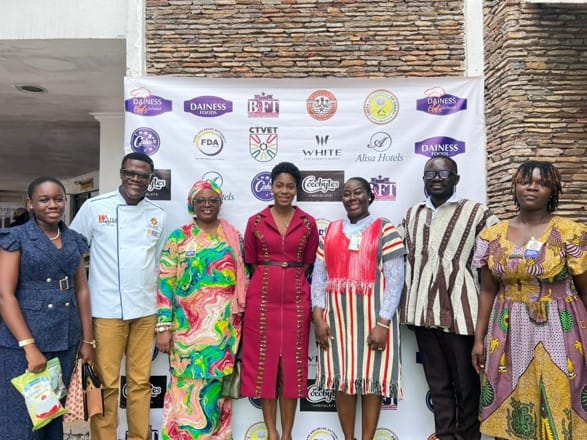
Dainess Chef School has hosted the third edition of its annual Culinary Expo, bringing together chefs, hospitality professionals, culinary students, food entrepreneurs and industry stakeholders to explore how Ghanaian cuisine can be reimagined through modern techniques while retaining its cultural identity.
Held at the Ghana Academy of Arts and Sciences in Accra under the theme ‘Culinary Innovations: A Ghanaian Perspective’, the Expo featured practical demonstrations, industry discussions and knowledge-sharing sessions focused on technical excellence, creativity and innovation in Ghanaian cuisine. The Expo forms part of Dainess Chef School’s commitment to developing culinary talent and creating platforms through which professionals and aspiring chefs can strengthen their technical skills, exchange ideas and explore new possibilities for Ghanaian food.
Principal of Dainess Chef School, Ms. Pamela Sarkodee, said the initiative was established as a Corporate Social Responsibility effort to contribute to the development of Ghana’s wider culinary ecosystem.
“This Expo, at its core, is a Corporate Social Responsibility initiative; a deliberate, conscientious, and sustained commitment by Dainess Chef School and its partners to give back to the industry that has nurtured us, to the nation that sustains us, and to the youth who look to us for direction,” she said.
Ms. Sarkodee said Ghana possessed the ingredients, talent and heritage required to compete internationally, but needed stronger infrastructure for culinary innovation, including training, industry networks, policy support and greater exposure.
“We have the ingredients. We have the talent. We have the heritage. What we require now is the infrastructure of innovation, the networks, the policies, the training, the exposure, and the confidence to compete on the global stage,” she said.
She stressed that innovation should not mean abandoning Ghanaian culinary traditions, but finding new ways to express them.
“Culinary innovation, from a Ghanaian perspective, is not the wholesale adoption of foreign cuisine. It is the intelligent, respectful, and creative reinterpretation of our indigenous produce. Our grains, our tubers, our spices, our leafy greens, our seafood, our fruits, our heritage,” she said.
The Expo brought this philosophy to life through demonstrations that included transforming plantain using gelification techniques and creating boba pearls from cassava flour, showcasing the potential of familiar Ghanaian ingredients when combined with contemporary culinary methods.
General Manager of Dainess Chef School, Mr. Frank Antwi, said the Expo was designed to go beyond recipes and demonstrations by equipping participants with knowledge and techniques that can be applied across different culinary settings.
“Food education and growth go beyond learning recipes. As a chef, you need to understand food safety, nutrition, food science, presentation, costing, technology and the expectations of the customer,” he said.
Mr. Antwi said techniques such as molecular gastronomy could help chefs transform the texture, temperature, aroma, appearance and presentation of food, creating new culinary experiences while preserving the identity of Ghanaian cuisine.
“Our objective should not be to abandon Ghanaian food. Rather, we should preserve our culinary heritage while using knowledge, science, quality and creativity to present Ghanaian cuisine in a new and exciting way,” he said.
The Expo also highlighted the importance of professional standards and certification in strengthening the culinary sector.
President of the Hospitality Alliance of Ghana and chef, Joseph Wilson Tetteh, called for stronger professional certification for chefs, minimum standards for culinary training institutions and greater collaboration between training institutions and industry. He said inadequate equipment and inconsistent training standards remained challenges for some institutions and stressed the need for structured practical training to complement classroom instruction.
Chef Wilson also advocated the use of standard operating procedures in commercial kitchens to improve consistency in recipes, taste and service delivery.
“If you are a guest, you are a client; you come there to eat, you realise that there will be fluctuation in quality, fluctuation in taste, and nobody likes that. I like it; I come, I should get the same thing. Or better. You should not be going down,” he said.
Speaking on behalf of the Minister for Tourism, Arts and Culture, Ms. Eunice Martey Anakwah said Ghana’s culinary sector could play a greater role in tourism promotion and cultural diplomacy. She described food as “our most delicious culture ambassador”, noting that dishes such as jollof and kelewele, alongside locally produced chocolate, could help communicate Ghanaian culture to international audiences.
“When we innovate with our traditional breakfast, millet, corn and cocoa, just to mention a few, and present them with world-class standards, they are not just cooking. They are doing diplomacy for Ghana,” she said.
Ms. Anakwah said continuous training and retraining would be essential to ensuring that Ghanaian culinary products and services meet the standards expected by international visitors and consumers.
The Expo also featured a chocolate demonstration by Chief Executive Officer of Chocolate Mall, Ms. Shirley Temeng, who introduced participants to aspects of chocolate production and its application in baking, confectionery and other culinary processes. Ms. Temeng emphasised the importance of understanding chocolate composition and percentage when selecting products for specific culinary applications, while highlighting opportunities for greater local value addition to Ghana’s cocoa.
Other demonstrations were delivered by Chef Amoa from the Chefs Association of Ghana, White Restaurant, Alisa Hotel, Dainess Chef School, Chocolate Mall and other culinary professionals.
A session by TIME 100 recognised culinary creator, Chef Abbys, titled “From Content Creation to Global Recognition,” explored how culinary professionals can use storytelling, creativity and digital platforms to build audiences and promote Ghanaian cuisine to consumers beyond Ghana.
The Expo was supported by the Ministry of Tourism, Arts and Culture, Ghana Tourism Authority, Chefs Association of Ghana, Commission for Technical and Vocational Education and Training (CTVET), and the Food and Drugs Authority. Dainess Chef School said the third edition of the Culinary Expo reinforces its commitment to nurturing culinary talent, promoting innovation, strengthening professional standards and creating opportunities for knowledge-sharing across Ghana’s hospitality and culinary industry.
About Dainess Chef School
Established in 2018, Dainess Chef School is a culinary training institution in Ghana established to meet the need for advanced professional culinary education. The school seeks to groom aspiring chefs, sharpen the skills of established culinary professionals and passionate cooks, and contribute to raising culinary standards in Ghana. Its programmes combine practical, hands-on training with professional instruction, food safety, creativity and real-world kitchen experience, with the aim of preparing students for careers in the food and hospitality industry.
